
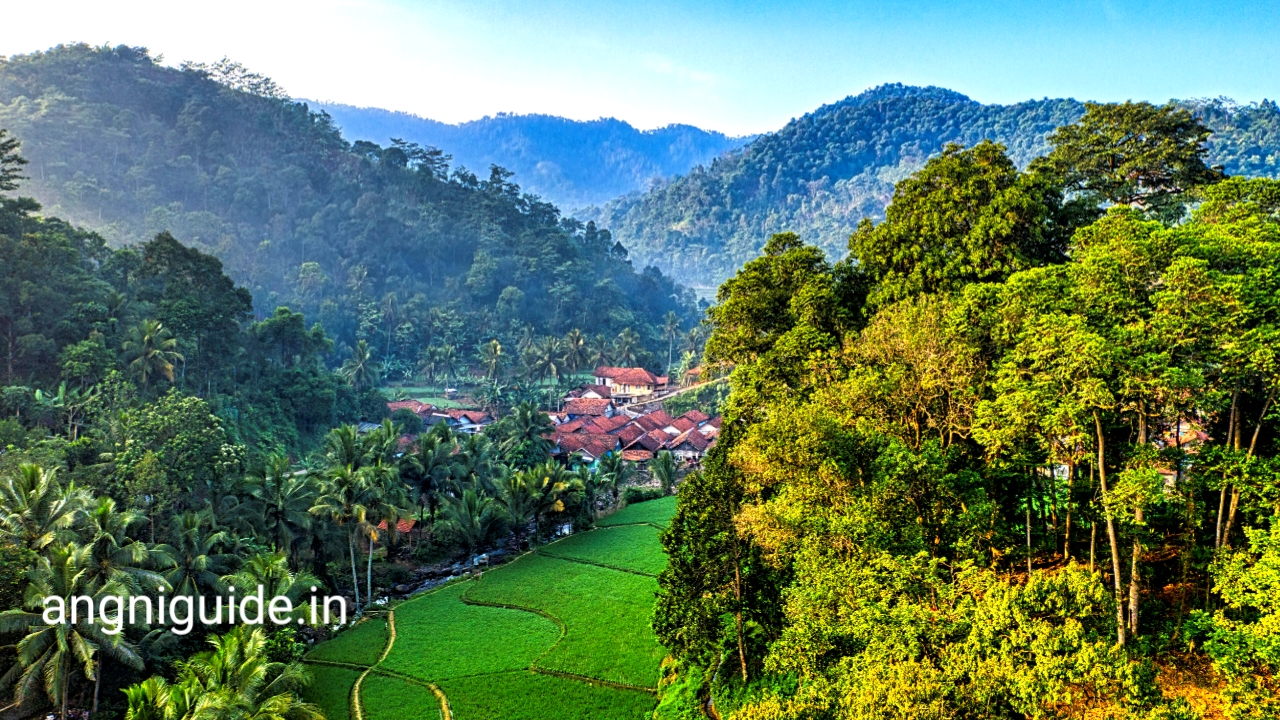
Sacred Groves and forest sanctuaries in Meghalaya are patches of ancient forest preserved by indigenous communities, particularly the Khasi, Jaintia, and Garo tribes, due to deeply rooted spiritual and cultural beliefs. These groves are considered the abode of local deities and ancestral spirits, and strict taboos prevent the removal of any plant, animal, or even a fallen leaf. They play a vital role in conserving biodiversity and traditional ecological knowledge.
In contrast, a forest sanctuary like Nokrek or Balpakram is a government-protected area aimed at wildlife conservation, often open to eco-tourism, scientific research, and regulated activities under forest and wildlife laws.
1. Mawphlang
Mawphlang, Meghalaya – A Sacred Grove of Nature and Culture
Mawphlang is a picturesque village located about 25 kilometers from Shillong, the capital of Meghalaya. Nestled in the East Khasi Hills district, it is most famous for the Mawphlang Sacred Grove, a protected forest revered by the local Khasi tribe as holy. This ancient grove is believed to be the dwelling place of forest spirits, and nothing is allowed to be taken from it—not even a fallen leaf—due to deep-rooted traditional beliefs.
The Sacred Grove, spanning around 78 hectares, is a biodiversity hotspot. It is home to rare medicinal plants, orchids, ferns, and ancient trees. The thick canopy and the untouched nature of the forest offer a unique ecological experience. Visitors often explore it with the help of local guides, who share fascinating legends and stories tied to the grove.
Mawphlang is also culturally significant as a center of Khasi heritage. The village hosts traditional monoliths and stone altars used for rituals and community gatherings. One of the major attractions is the David Scott Trail, a scenic trekking route named after a British officer. This trail connects Mawphlang to Lad Mawphlang and offers panoramic views of rolling hills, rivers, and traditional Khasi villages.
The area is increasingly popular among eco-tourists and cultural explorers. Despite its growing popularity, Mawphlang retains its serene and untouched charm. The village also promotes sustainable tourism, ensuring the preservation of its cultural and natural heritage.
Best visited between October and April, Mawphlang provides an immersive experience in nature, folklore, and tribal tradition. Whether you’re a nature lover, a trekker, or a cultural enthusiast, Mawphlang offers a peaceful and enriching retreat in the heart of Meghalaya’s highlands.
Also Read:
Top 10 Best Engineering Colleges in kokrajhar 2026
2. Nongriat
Nongriat, Meghalaya – Home of the Living Root Bridges
Nongriat is a remote, serene village nestled deep in the East Khasi Hills of Meghalaya, about 60 kilometers from Shillong and accessible via a steep trek from the village of Tyrna, near Cherrapunji. This small village has gained international fame for being home to one of Meghalaya’s most iconic wonders, the Double Decker Living Root Bridge.
These root bridges are a unique example of bioengineering by the Khasi tribe. Made from the aerial roots of the rubber fig tree (Ficus elastica), the bridges are carefully guided over decades to grow across streams and rivers. The Double Decker Bridge in Nongriat is one of the most impressive, offering a surreal sight and a living connection between nature and human ingenuity. There’s even a third level under development, which could make it the only triple-decker root bridge in the world.
The journey to Nongriat involves descending over 3,000 steps from Tyrna, making it physically demanding but incredibly rewarding. Along the way, trekkers are treated to stunning views of dense forests, waterfalls, and crystal-clear natural pools. One such natural pool is the Rainbow Falls, a short trek from the village and named for the rainbow that often forms in its mist.
Nongriat is also known for its warm and hospitable local community, who offer simple but comfortable homestays and traditional Khasi meals. The village has no road access, making it a peaceful retreat surrounded by nature.
Visiting Nongriat is more than a sightseeing trip — it’s an immersive experience in sustainability, local wisdom, and breathtaking natural beauty. Ideal for trekkers, nature lovers, and cultural explorers, Nongriat remains one of Meghalaya’s most treasured hidden gems.
3. Balpakram National Park
Balpakram National Park, Meghalaya – The Land of Spirits
Balpakram National Park is a stunning and remote wildlife sanctuary located in the South Garo Hills district of Meghalaya, near the international border with Bangladesh. Spanning over 220 square kilometers, it lies at an altitude of around 3,000 feet above sea level and is part of the rich and biodiverse Garo Hills ecosystem. The name “Balpakram” means “land of the perpetual winds” in the local Garo language and is often referred to as the “Land of Spirits” due to its deep spiritual significance in Garo mythology.
The park is a biodiversity hotspot, home to a wide range of flora and fauna. It harbors several rare and endangered species such as the red panda, Asian golden cat, clouded leopard, wild water buffalo, and even the elusive Indian bison (gaur). It is also a haven for birdwatchers, with species like the hornbill, rufous-necked hornbill, and other tropical birds found in abundance.
Balpakram’s terrain is dramatic and diverse, with deep gorges, dense forests, grasslands, and natural limestone caves. One of the most notable features is the Balpakram Gorge, a canyon-like formation shrouded in mystery and local legend. The Garos believe it to be the resting place of departed souls before they journey to the afterlife, adding a mystical aura to the park.
The best time to visit Balpakram is between October and March, when the weather is pleasant and wildlife sightings are more frequent. Due to its remote location, travel requires planning, usually starting from Tura, the nearest major town.
Balpakram is not just a national park — it’s a blend of myth, wilderness, and natural beauty, making it one of Meghalaya’s most unique and sacred ecological treasures.
4. Nokrek National Park
Nokrek National Park, Meghalaya – A UNESCO Biosphere Reserve
Nokrek National Park is a vital protected area located in the West Garo Hills district of Meghalaya, about 2 km from Tura Peak and around 140 km from Shillong. Covering an area of approximately 47.48 square kilometers, it lies in the heart of the Garo Hills and is part of the larger Nokrek Biosphere Reserve, which was designated a UNESCO Biosphere Reserve in 2009.
The park is best known as the home of the red panda (also locally known as the “fire fox”), although sightings are rare due to the species’ elusive nature. It is also known for harboring a population of Hoolock gibbons (India’s only ape), Asian elephants, clouded leopards, leopard cats, capped langurs, and gaurs (Indian bison). Nokrek is also a paradise for birdwatchers, with species like the great hornbill, kalij pheasant, and white-rumped vulture found in the region.
Nokrek is heavily forested with tropical and subtropical vegetation, including rare and endemic plant species. One of the park’s most significant features is the presence of the mother germplasm of Citrus indica, a wild variety of orange considered to be the genetic ancestor of all citrus fruits. The National Citrus Gene Sanctuary is located within the biosphere for its conservation.
The terrain of Nokrek is hilly and rugged, with thick forest cover and several crystal-clear streams. The highest peak in the Garo Hills, Nokrek Peak, lies within the park and offers panoramic views of the surrounding forested landscape.
Accessible via Tura, the park is best visited between October and April. Nokrek National Park represents an incredible mix of rich biodiversity, ecological importance, and tribal culture, making it one of Meghalaya’s most important and fascinating natural reserves.
Also Read:
Dwijing Festival 2025-2026 Date in Assam
5. Siju Bird Sanctuary
Siju Bird Sanctuary, Meghalaya – A Haven for Winged Wonders
Siju Bird Sanctuary is one of Meghalaya’s most important and lesser-known bird sanctuaries, located near Siju village in the South Garo Hills district. Situated on the banks of the Simsang River, the sanctuary lies close to the Siju Caves and is part of the broader Balpakram-Baghmara region, which is rich in biodiversity and ecological significance.
The sanctuary is particularly renowned for being a wintering ground for migratory birds, especially various rare and endangered species. Among its most famous avian visitors are the Siberian ducks, which arrive during the colder months. Other bird species commonly sighted include hornbills, green pigeons, pheasants, peafowls, spoonbills, drongos, and scarlet minivets. The grey hornbill and the great Indian hornbill are among the sanctuary’s highlights, often spotted in the early morning or late afternoon.
Dense subtropical forests and the proximity to rivers and wetlands create an ideal habitat for both resident and migratory birds. Apart from birds, the sanctuary is also home to small mammals, reptiles, and a variety of butterflies, adding to its ecological richness.
One of the key attractions near the sanctuary is the Siju Dobakkol (Siju Cave), one of the longest limestone caves in India and known for its impressive stalactites and stalagmites. Combining a visit to the sanctuary with an exploration of the caves makes for a complete eco-tourism experience.
Best visited between November and March, Siju Bird Sanctuary is a paradise for birdwatchers, photographers, and nature enthusiasts. Its peaceful surroundings, coupled with the melody of birdsong and the natural beauty of the Garo Hills, offer a serene escape into nature.
Though relatively unexplored, Siju Bird Sanctuary stands out as a critical conservation area and a must-visit destination for those seeking Meghalaya’s hidden gems.
Conclusion:
Sacred groves and forest sanctuaries in Meghalaya highlight the deep connection between nature, culture, and conservation. While sacred groves reflect community-led preservation rooted in tradition, forest sanctuaries represent formal protection by law. Together, they play a crucial role in safeguarding Meghalaya’s rich biodiversity and sustaining ecological balance.