
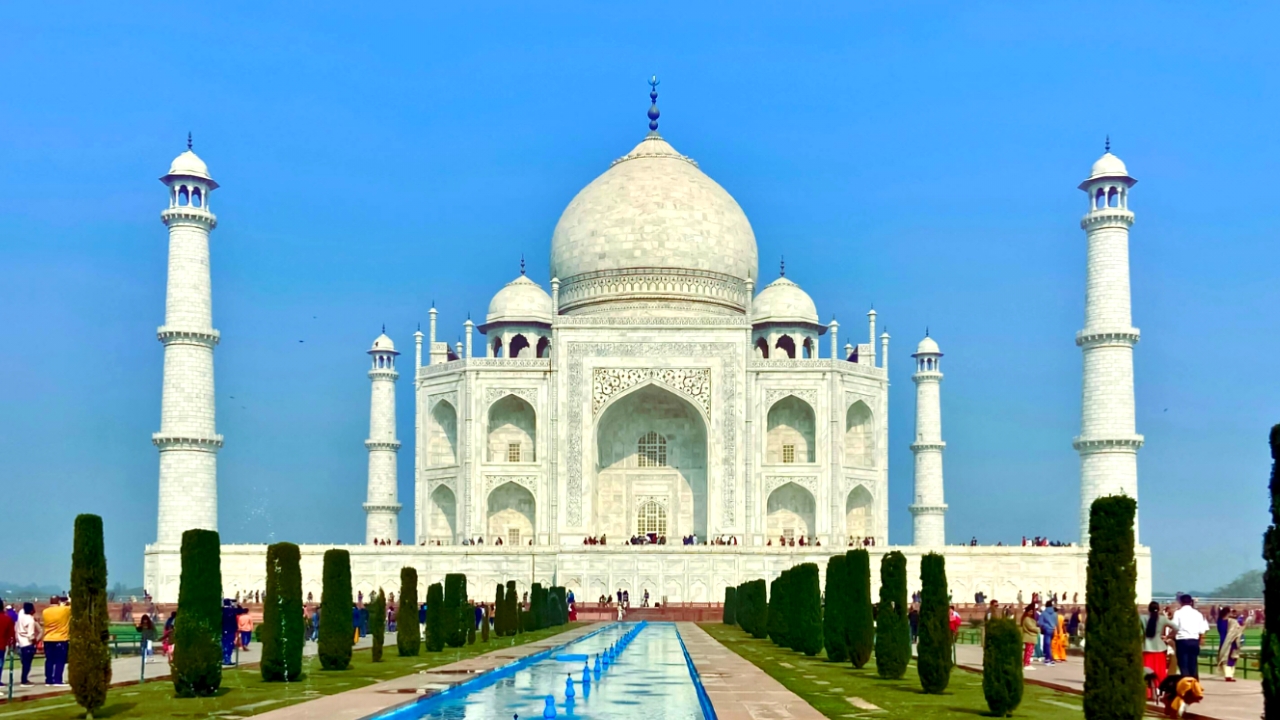
The Taj Mahal, one of the world’s most romantic monuments, is a perfect destination for couples visiting Agra. Built by Emperor Shah Jahan in memory of his beloved wife Mumtaz Mahal, it symbolizes eternal love and devotion. Couples can admire its breathtaking white marble architecture that glows differently with the changing light of day — pink at dawn, milky white by day, and golden under moonlight. A walk hand in hand through the beautiful Mughal gardens, with the Taj reflected in the long water channels, creates an unforgettable experience. Many couples also enjoy capturing photographs at the iconic marble bench, with the Taj Mahal as a backdrop.
For a more magical view, watching the monument at sunset or under a full moon offers a truly romantic atmosphere. The Taj Mahal’s timeless beauty and emotional story make it a dream destination for lovers around the world.
1. Taj Mahal
Rudyard Kipling once described the Taj Mahal as “the embodiment of all things pure,” and indeed, his words ring true — the Taj remains an eternal symbol of beauty and grace. Often called a poem in white marble, it stands as the most exquisite expression of an emperor’s love for his queen. Situated on the banks of the River Yamuna, this magnificent mausoleum was commissioned by Mughal Emperor Shah Jahan in 1631 in memory of his beloved wife, Mumtaz Mahal. She passed away while giving birth to their child, leaving behind a final wish — that her husband build a monument unlike any the world had ever seen. Fulfilling her wish took more than 17 years, the labor of 22,000 artisans, and the strength of 1,000 elephants.
The Taj Mahal is one of India’s three UNESCO World Heritage Sites and stands serenely within a classic Mughal garden. Perched on a raised marble platform overlooking the Yamuna, it is perfectly symmetrical on all four sides. Each façade is adorned with majestic arches, delicate Pietra Dura inlay work, and verses from the Quran inscribed in graceful calligraphy with inlaid jasper. This architectural masterpiece continues to captivate visitors from across the world — photographers, travelers, and admirers alike — appearing as pristine today as it did centuries ago, forever leaving those who behold it in awe.
2. Agra Fort
Standing majestically on the banks of the River Yamuna, Agra Fort is a grand red-sandstone fortress commissioned by Emperor Akbar in 1565 and later expanded by his grandson, Shah Jahan. Designed in a semi-circular plan, the fort is enclosed by towering walls that rise to 21.4 meters, emphasizing its original purpose as a formidable military stronghold — parts of which remain under the control of the Indian Army to this day.
Though Akbar built it for defense, Shah Jahan transformed the fort into a splendid royal residence. Ironically, it later became his gilded prison, where he spent the final eight years of his life after being overthrown by his son Aurangzeb in 1658. Within its walls lies a fascinating labyrinth of palaces, halls, and courtyards, some extending into vast underground chambers.
The sole entry point, the Amar Singh Gate on the southern side, leads visitors through a winding path to the grand Moti Masjid (Pearl Mosque). Just before reaching it stands the Diwan-e-Aam (Hall of Public Audience), where Shah Jahan once heard petitions from his subjects. A small staircase beside the throne in Diwan-e-Aam ascends to a spacious courtyard, home to the elegant white marble Nagina Masjid.
Among the fort’s many architectural jewels are the Diwan-e-Khas, which once housed Shah Jahan’s legendary Peacock Throne and the famous Koh-i-Noor diamond; the Shish Mahal, adorned with walls of intricate mirror work; and the Khas Mahal, an exquisite white marble palace and octagonal tower. To the south stands the grand Jahangir’s Palace, built of red sandstone by Akbar, most likely for his son Jahangir.
A blend of power, artistry, and history, Agra Fort remains one of India’s most captivating monuments — a timeless witness to the grandeur and turbulence of the Mughal era.
Also Read:
Top Law Colleges In India 2026 Fees Cut Off
Sacred Groves And Forest Sanctuary In Meghalaya Tour
3. Sikandra / Akbar’s Tomb
Situated on the western outskirts of Agra, Akbar’s Tomb at Sikandra is a magnificent blend of red sandstone and white marble. The construction of this grand mausoleum was initiated by Emperor Akbar himself and later completed by his son, Jahangir. The interiors are adorned with beautiful calligraphy reflecting the principles of Din-i-Ilahi — Akbar’s unique spiritual doctrine that sought to unite elements of Hinduism, Islam, and other faiths.
The tomb serves as the final resting place of the great Mughal emperor, whose grave lies in a serene, dimly lit chamber. Surrounding the tomb is a vast Charbagh-style garden, divided symmetrically into four parts, adding to the monument’s tranquil charm.
4. Itmad-ud-Daula
Often referred to as the “Baby Taj,” the tomb of Itmad-ud-Daula is a masterpiece of Mughal architecture and a forerunner to the Taj Mahal. Commissioned by Empress Noor Jahan in memory of her father, Mirza Ghiyas Beg, between 1623 and 1628, this exquisite structure is built entirely of white marble. Intricately inlaid with semi-precious stones and delicate lattice screens, the tomb radiates a dazzling beauty that continues to captivate visitors from around the world.
5. Chini Ka Rauza
Located just one kilometer from the tomb of Itmad-ud-Daula, Chini Ka Rauza is the mausoleum of Afzal Khan Mullah, Shah Jahan’s Prime Minister and a noted Persian poet. The monument stands amidst beautifully landscaped gardens and is renowned for its distinctive blue-glazed tilework. The tiles, made from Chini Mitti or “Chinese Clay,” were imported from China, lending the monument its name.
While much of the exterior glaze has faded over time, traces of the original porcelain tiles and intricate floral paintings can still be seen. The structure reflects an exquisite fusion of Persian artistry and Mughal elegance and is open to visitors from sunrise to sunset.
6. Mariam’s Tomb
Just a kilometer away from Akbar’s Tomb lies the resting place of his wife, Mariam-uz-Zamani — formerly the Rajput princess Heer Kunwari, who married Akbar in 1562. After she died in 1623, their son, Emperor Jahangir, built this elegant red sandstone tomb in her memory near Sikandra, along the Delhi–Agra National Highway.
The tomb’s architecture is remarkable for its intricate carvings and geometric designs. The ground floor consists of around forty chambers, originally built by Sultan Sikandar Lodi, which still bear faint traces of painted plaster. The central chamber houses Mariam’s cenotaph, while the facades are richly adorned with carved panels and ornamental towers capped by pavilions supported on slender pillars. The marble cenotaph on the upper floor lies open to the sky, symbolizing peace and eternity — a fitting tribute to one of the most influential queens of the Mughal era.
7. Ram Bagh
Ram Bagh is one of the earliest Mughal gardens, believed to have been laid out by Emperor Babur, the founder of the Mughal Dynasty. Located about 3 km from the Tomb of Itmad-ud-Daula and just 500 meters from the Chini ka Rauza, it is Agra’s oldest garden, established in 1528. Amidst the hustle and bustle of the surrounding market, Ram Bagh stands as a serene oasis. It is said that Babur was temporarily buried here before his remains were taken to Kabul, Afghanistan.
The garden was created by Babur and later renovated by Noor Jahan, the wife of Emperor Jahangir.
8. Nagina Masjid
Nagina Masjid, situated within the Agra Fort near the Moti Masjid, is a splendid mosque built entirely of pure white marble. Constructed in the north-western corner of the Machchi Bhawan, it was meant for the Emperor’s private use. The mosque features a marble-paved courtyard enclosed by walls on the north, south, and east, with the prayer chamber located to the west.
The prayer hall, also built of marble, is crowned with three domes. Its façade comprises three arches supported by slender piers, with the central arch being larger and adorned with nine cusps, while the flanking arches have seven each. The architectural detailing and symmetry make Nagina Masjid a fine example of Mughal artistry.
Also Read
Top 10 IIT Colleges In India Rank Wise, Admission Fee 2026
Top Commerce Colleges In Mumbai For 11th And 12th Fee
9. Mehtab Bagh
Mehtab Bagh lies on the left bank of the River Yamuna, directly opposite the Taj Mahal. Originally built by Emperor Babur as the last in a series of eleven gardens along the Yamuna’s banks, this square-shaped garden complex measures approximately 300 by 300 meters (980 ft × 980 ft). Perfectly aligned with the Taj Mahal, it offers a breathtaking view of the monument, especially at sunset. Excavations at the site have revealed a large octagonal tank at the center and a gateway on the northern wall.
Today, Mehtab Bagh is regarded as one of the best vantage points to admire the timeless beauty of the Taj Mahal.
10. Jama Masjid
The Jama Masjid of Agra is one of the largest mosques built by the Mughals in India. Constructed in 1648 A.D. by Jahanara Begum, the daughter of Emperor Shah Jahan, it features a vast rectangular courtyard and showcases a splendid fusion of Mughal and Iranian architectural styles. Built using red sandstone and white marble, the mosque took six years to complete and required the labor of approximately 5,000 workers.
The elegant design and grandeur of the structure make it a significant landmark of Mughal architecture in Agra.
11. Guru Ka Taal
Guru Ka Taal is a renowned Gurudwara in Agra, both historically and spiritually significant. Construction of the Gurudwara began in the 1970s, and it is believed that four of the ten Sikh Gurus visited this sacred site. The Gurudwara attracts thousands of devotees and tourists every year, who come to pay homage to the great Sikh Gurus. Its elaborate stone carvings and impressive architectural design make it one of the most beautiful religious monuments in India. Guru Ka Taal stands as a symbol of devotion, peace, and architectural splendor.
Here’s a rewritten and polished version of your text — clear, engaging, and well-structured, while keeping all your original details and meaning intact:
Food in the Agra Taj Mahal
Agra is not only home to the magnificent Taj Mahal but also to a wide variety of delectable foods that reflect its rich Mughlai heritage and vibrant street culture. From sweet treats to spicy snacks, here are some of the city’s must-try dishes.
Petha
Agra is synonymous with Petha, a traditional sweet made from white pumpkin (ash gourd) and infused with various flavors. This translucent, sugary delight comes in multiple forms and textures — the dry, chewy kind and the soft, syrupy one. Popular varieties include Plain (White) Petha, Kesar (Saffron) Petha, Angoori Petha, and Paan Petha.
Petha is also believed to have medicinal benefits — it helps regulate blood pressure, supports hydration, and promotes brain health. For the most authentic taste, head to Panchi Petha at Hari Parvat Crossing, a legendary spot known for its irresistible versions of this sweet.
Dalmoth
Dalmoth is Agra’s signature savory snack — a spicy, crispy mix of nuts, lentils, and spices. This traditional namkeen is crunchy, slightly oily, and full of flavor, making it the perfect companion to a hot cup of tea.
You can buy high-quality Dalmoth at Panchi Petha and in the Baluganj area. Usually packed in boxes or bags, this classic snack makes for a great souvenir and a fiery treat for your taste buds.
Bedhai & Jalebi
A visit to Agra is incomplete without a traditional Bedhai-Jalebi breakfast. This sweet-and-spicy combo is a local favorite, typically sold at bustling street stalls.
Bedhai is a fried, puffy bread similar to kachori, served with a spicy potato-based curry and a dollop of curd. Paired with Jalebi — golden spirals of fermented batter fried and soaked in syrup — this meal is both hearty and satisfying.
For the best Bedhai and Jalebi, visit GMB or Shree Ji Sweets on Fatehabad Road.
Paratha
Agra is also famous for its Parathas, a popular dish rooted in Mughlai cuisine. These pan-fried flatbreads are typically vegetarian, stuffed with fillings like potatoes, cauliflower, carrots, or cheese. Served hot with curd, pickle, and chutney, Parathas make for a wholesome and fulfilling breakfast.
For authentic flavors, head to Rambabu Parathe Wale on the Old Delhi–Agra Highway, where the parathas are legendary.
Mughlai Food
The Mughal emperors left behind more than just architectural wonders — they also shaped Agra’s culinary identity. Mughlai cuisine is rich, aromatic, and indulgent, featuring meats cooked in creamy gravies with ground and whole spices, nuts, and dried fruits.
When the Mughals made Agra their capital in the 16th century, their royal kitchens inspired dishes that continue to define the city’s food culture today. For the most authentic Mughlai experience, visit Nai Ki Mandi on MG Road, or dine at Indiana, Pinch of Spice, or Taj Mahal Restaurant on Fatehabad Road.
Chaat
Agra’s street food scene wouldn’t be complete without Chaat, a favorite evening snack. While samosas, gol gappas, and raj kachoris are popular, the city especially loves its Bhallas.
Agra-style Bhalla is a crispy fried patty made from potatoes and chickpeas, smashed and topped with grated ginger, tangy tamarind chutney, and spicy masalas. These are larger and crispier than those found elsewhere — an irresistible treat for chaat lovers.
For the best experience, explore Chaat Wali Gali in Sadar Bazar, where the aroma and flavors of street chaat fill the air.
Why is travelling important?
Traveling is important because it broadens our perspective and helps us understand the world beyond our daily surroundings. It allows us to experience different cultures, traditions, and lifestyles, which fosters empathy, tolerance, and appreciation for diversity. Traveling also provides opportunities for personal growth — it challenges us to step out of our comfort zones, adapt to new situations, and build confidence.
Exploring new places can be both relaxing and inspiring, offering a break from routine and helping to reduce stress. Moreover, travel enriches our knowledge of history, geography, and nature, making learning more meaningful and memorable.
Whether it’s a short trip or a long journey, traveling creates lasting memories and connections with people from around the world. Ultimately, it reminds us that the world is vast, beautiful, and full of opportunities to learn, grow, and discover ourselves.