
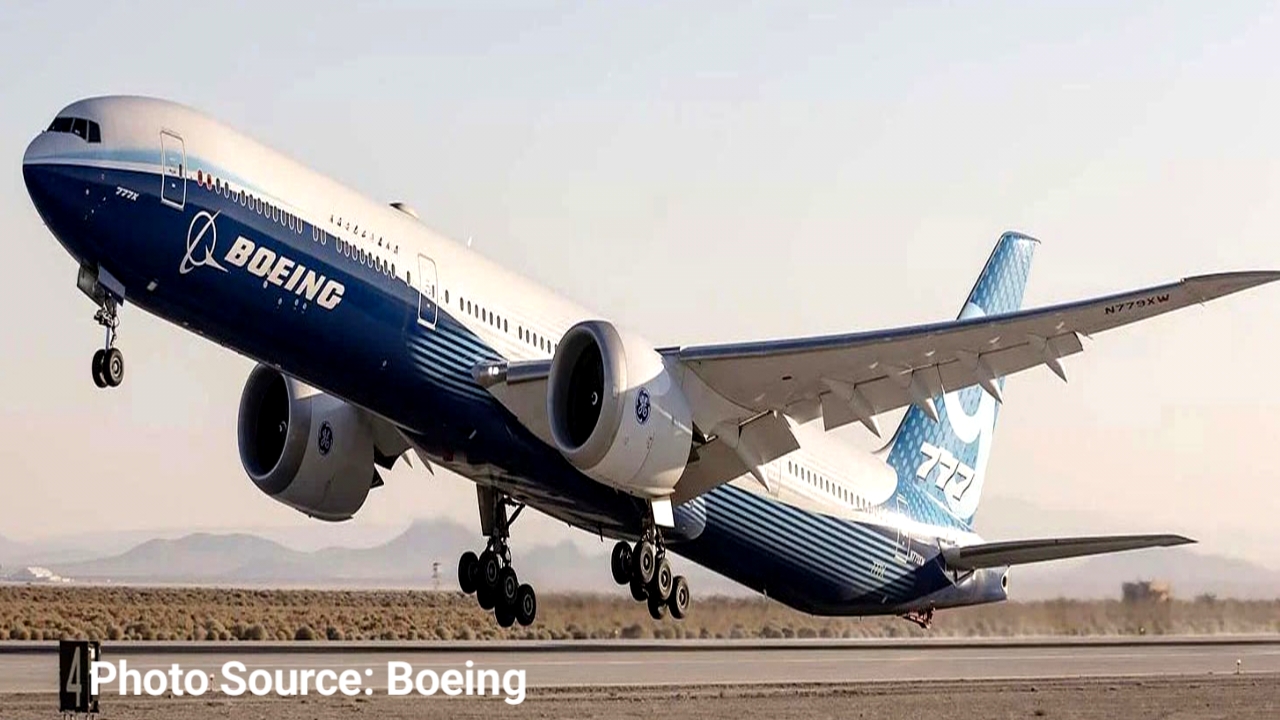
Boeing Posts $4.9 Billion Loss as 777X Delivery Delayed to 2027. Boeing, despite maintaining strong technical expertise, faces the challenge of restoring customer confidence amid further delays to its long-awaited 777X widebody aircraft. The company has postponed the program’s entry into service once again, with first deliveries now expected in 2027. Alongside the delay, Boeing announced a $4.9 billion charge against the program, compounding pressure on its already weak quarterly results.
This marks the sixth major setback for the 777X since its 2013 launch, driven by ongoing operational and regulatory challenges. Boeing cited slow progress on Federal Aviation Administration (FAA) certification and persistent production issues as the primary causes for the revised timeline.
The 777X Program: Ambition Meets Turbulence
The 777X, envisioned as the next-generation successor to the 777 family, features composite wings with folding wingtips, GE9X engines, and a cabin capable of carrying up to 426 passengers. Designed to rival the Airbus A350, it promised improved efficiency, extended range, and compatibility with existing airport infrastructure.
However, the program has faced repeated hurdles. Early delays stemmed from engine reliability problems and structural failures, requiring significant redesigns of the wing and fuselage. Later, stricter certification requirements introduced after the 737 MAX crisis further slowed development. By 2025, total program costs are projected to approach $15 billion, making the 777X one of Boeing’s costliest commercial aircraft projects.
Also Read:
iOS 26.1 Arrives Soon: Release Candidate Offers a First Look at New iPhone Features
Financial Strains and Industrial Pressures
The $4.9 billion write-down hit Boeing’s third-quarter results hard, contributing to a net loss of around $6 billion. Analysts attribute the charge to customer compensation for delivery delays and adjusted production rates. Production has also been affected by a machinist strike earlier this year, temporarily halting key manufacturing lines. While Boeing says the strike did not directly cause the latest postponement, it worsened existing bottlenecks.
CEO Kelly Ortberg, who took over in early 2025, emphasized operational discipline and transparency with regulators. Yet repeated delays have strained relationships with major customers, including Emirates, Lufthansa, and Qatar Airways, which account for a significant portion of the program’s more than 500 orders.
Competition and Market Implications
The 777X’s setbacks draw uncomfortable parallels to the 737 MAX crisis, raising questions about whether Boeing’s internal expertise has weakened. Meanwhile, Airbus is capitalizing on the delays, with the A350-1000 gaining market traction and airlines moving to secure orders to fill the void.
Boeing’s ability to regain trust hinges on delivering the 777X without further disruption. Ongoing FAA scrutiny makes this task especially challenging. The aircraft’s ultimate success—or failure—will shape Boeing’s position in the widebody market for the next decade.
Looking Ahead
Boeing plans to increase flight testing and collaborate closely with the FAA in 2026 to resolve outstanding certification hurdles. The first delivery, now slated for early 2027, is expected to go to Emirates. Positioned between the 787 Dreamliner and the soon-to-be-retired 747, the 777X remains central to Boeing’s recovery strategy. But with rising costs, regulatory oversight, and strong competition from Airbus, the program’s future is under intense scrutiny.